|
 |
 |
 |
 |
 |
 |
|
|
 |
|||||||
 |
||||||||
|
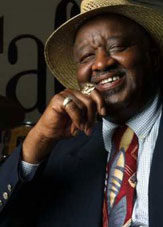
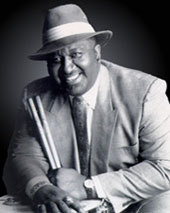
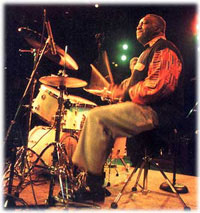
Bernard Purdie | |||||||
|
 |
|||||||
| ... did he really record with The Beatles? | ||||||||
But wait! While it's true that Purdie's name appears on hundreds of albums released during the past 60 years, he has never been officially credited for his work with The Beatles. In fact, the only known source for this astonishing bit of music trivia is Bernard Purdie himself! Period. In a number of published interviews, beginning in the mid-70's and continuing to the present day, Purdie claims to have overdubbed or substituted for Ringo on twenty-one Beatle recordings! |
||||||||
|
 |
|||||||
|
Here's an
excerpt from Max Weinberg's excellent book, "The
Big Beat" (1984):
Weinberg: You played on Beatles' tracks? Purdie: Twenty-one of them. Weinberg: Do you remember which ones? Purdie: Ummhmm. Weinberg: Which ones? Purdie: That's information I don't disclose. Weinberg: Why won't you name the tracks? Purdie: Because if I need that information to get me some money, then I'll have what's necessary. I also played on songs by the Animals, the Monkees. Weinberg: Everyone knows the Monkees were a fabricated band, but The Beatles? Purdie: Ringo never played on anything. Weinberg: Ringo never played on anything? Purdie: Not the early Beatles stuff. |
|||||||
|
|
|||||||
|
Purdie
made similar claims in the February 1978 issue of "Gig" magazine,
saying he was hired to do a session during the summer of 1963, six months before the first Beatle
album was released in the U.S.A.
"I had never heard of The Beatles," said Purdie, "but their manager, Brian Epstein, called me and took me down to Capitol's 46th Street studio. I overdubbed the drumming on twenty-one tracks of the first three Beatle albums." He doesn't remember specific titles except one he calls 'Yeah Yeah Yeah' -- presumably 'She Loves You'. "I got paid in five figures [$10,000 or more]," Purdie adds, "and that was the largest amount of money I'd ever gotten in my life. I thought they were paying me all that money because they liked what I played. Then [Epstein] told me I was being paid to keep my mouth shut." Purdie says he signed a contract. Does he still have it? "The contract", he explains, "was the check that I signed -- and I cashed it! On the back of the check, it was spelled out what I did ... 'payment for services rendered'. It took up half the check. But I didn't think about making a photo-copy. It didn't mean anything to me." Purdie says he worked on finished tapes. Seeing as the early Beatle albums had already been released in England, this would mean the original English versions have Ringo doing the drumming while the American counterparts have Purdie on some tracks, Ringo on others, and, as Purdie suggests, both of them on others. "They had four track [tape recorders] and they put me on two separate tracks. I would listen to what Ringo had played and then overdub on top of it to keep it happening." He says he never met any of The Beatles at the time. "The only people in the studio were me, the engineer, and Brian Epstein and a few of his people." Purdie says he doesn't even think Beatles producer George Martin knows what he did. George Martin would only say "I did not use another drummer", and no one at Capitol Records -- past or present -- knows anything or is willing to talk about it. "The manager did everything", Purdie stresses. "Epstein instigated everything that had to be done. He was the one who told me to keep my mouth closed. He was the one." |
|||||||
|
|
|||||||
|
Here's Purdie in a 2007 interview conducted before an audience at the Red Bull Music Academy in New Jersey:
Red Bull Music Academy: Talking of fixing records, there's a rumour ... Bernard Purdie: No, no, no. RBMA: ... that nobody really ever confirmed, that you may have fixed some of the Ringo Starr tracks for The Beatles. Bernard Purdie: The part that hurts, the real, real part that hurts, is that people do not understand ... fixing records was a way of life in the '60s and the '70s. It was a way of life fixing up records because ninety-eight percent of the groups, self-contained groups, are not on their own albums. They are not on their own album. And what I did, and what I was doing, was going in ... I was one of the few drummers who could actually go in, join the group, and make the records ... because the record companies were paying a lot of money to make these records happen. My thing was, I got along with everybody. I never went out and started hollering and complaining, "No that ain't so-and-so doing this, that and the other. And I just did a job. The Beatles music was just another job for me. Another job ... because half of the songs that I played, I played on 21 tracks of The Beatles ... half of them had no drums, because they kicked him (Ringo?) out in the beginning. And the whole point is ... whether you realize it or not, whether you want to believe it or not, it becomes irrelevant at this point, but you're gonna find out that he's not on anything. The man (Brian Epstein?) made his money, and his money, and everything else was made by lies. The man spent a million dollars promoting the Beatles. Brian Epstein spent money to promote The Beatles, and that was unheard of in the '60s, to spend that kind of money to do something. Ringo took somebody else's place in that band, 'cause that's who they wanted and that's who they could control. And that's all it was. It was all about control. He looked the part that they wanted, he (Ringo?) was the one that he (Epstein?) chose, and that's what they did. But the making of those records and the fixing of those records, ninety-eight percent of them were first recorded early in England and brought to the USA to be done and fixed. That's why Mercury Records and Capitol Records, they both have Beatles albums. I did mine in the Capitol studio in New York City. I had no idea who the hell The Beatles were or anything else. I was doing a job. And that for me is the hardest thing, because I've had my life threatened too many times, and at this point in my life I don't care anymore, and it really doesn't bother me whether I talk about it or do anything else about it, because I don't have to go back there or to deal with it in life anymore. And I'm very proud of it, for my sake. What he did, he made his money, he did what he needed to do, he doesn't have to answer to anybody else for what he's done. And it's a shame to, you know, for things to happen this way, but it did happen, and it has happened with too many other people. There are four drummers on The Beatles music, and Ringo's not one of them. |
|||||||
|
|
|||||||
|
Here's an edited excerpt from the May/June 1985 issue of "Drum!" magazine:
Diane Gershuny (Drum! magazine): I heard about the incident where a man was upset when he heard it wasn’t Ringo drumming on some of the Beatles tunes? Purdie: My life was threatened by quite a few people. It stopped me from naming the songs all together. I got paid for doing a job, and that’s what I’ve been doing. Practically every English act that came over here. That’s what I did. I had to replace the drums. And then when the ’70s started to come around, people started getting credits on albums. So I started saying I want credits, too. Drum: When will you reveal the titles of those Beatles tracks? Purdie: I’m in the process now of writing the book. it’s going to be interesting, and it’s also going to be about the truth. I realize it now, that yes, I made history. And I am the one who did it. I was there on the sessions. I was there with and without them. Drum: How did those Beatles sessions come about? Purdie: I’m going to bypass on most of that. I will tell you this much, there’s 21 tracks [that I played on]. And I have to kind of slide away from that until I’m ready to really do it. The other thing I can say is Ringo is not on anything. Drum: Nothing? Purdie: Nothing. I’m not the only one, but I think I’ll probably be the first one, basically, coming out with the autobiography. |
|||||||
|
|
|||||||
|
Here's an excerpt from an August 21, 2008 interview on "PodShow Radio":
Brent Bradley: The word is that you played on the first three Beatles' albums and that Ringo did not play on any of them. Is that true? Purdie: Well, it's true, but the point is that I'm going to leave that alone for the time being, because every time I open my mouth about that I've gotten myself into trouble ... but I think my book will satisfy a lot of people because we dealt with it, uhm, in a nice way, and people can make their own judgment ... the book should be coming out this, you know, this fall [2008]. Allegro will have it, but we, ah, I know that Barnes and Noble and the big book stores will all have them because my distributor Allegro is already, uh, gearing up to making sure these people have it. Podshow Radio (audio): |
|||||||
|
|
|||||||
|
And finally, here's an excerpt from a 2010 interview that appeared in the Andrew Zuckerman book, "Music":
Purdie: What I did was fix The Beatles' records. I fixed. Playing with them? No. What I did was fixed their records, so their records worked. I did twenty-one tracks fixing it up, before they even came over here ... I didn't know who The Beatles were. I didn't know anything. It was just records that I was fixing. They didn't give me any information. The man paid me to come in and fix these tracks." |
|||||||
|
||||||||
|
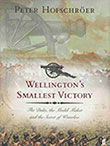
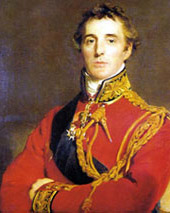
He claims to have replaced or overdubbed drums on twenty-one tracks on the Beatles' first three albums. Really? Consider this for a moment ... is it possible Bernard Purdie could be lying? It's not unprecedented for people of considerable accomplishment to also have considerable flaws. Take the Duke of Wellington for example. In 1812 he defeated Napoleon at the Battle of Waterloo, one of the most famous military victories in history! However, some historians believe that Wellington may have embellished a few facts to make his role at Waterloo seem even more significant than it was! I mean, dude, you defeated Napoleon. Why not just leave it at that?!? And what about Bernard Purdie? Might he be stretching the truth a bit? Or maybe stretching the truth a lot? In any case, Purdie's entitled to a fair hearing ... and thanks to his numerous interviews on the subject, he's given us more than enough information to get started. So, let's dissect the evidence, put it under a microscope, and see if Purdie's story holds up to closer scrutiny! |
|||||||
|
||||||||
Clue
#1: Purdie says, "Brian Epstein called me and took
me down to Capitol's 46th Street studio ... Epstein instigated everything
that had to be done." This is highly unlikely. Not only was Brian Epstein musically illiterate and technically unqualified to oversee a recording session, The Beatles were outspoken, even rude, in discouraging Epstein from meddling in their music. One episode in particular illustrates just how true this was. The incident is recounted by The Beatles' producer George Martin in his book "All You Need Is Ears" (a near-identical version of the story appears in Brian Epstein's autobiography, "A Cellarful of Noise"). Epstein wrote: "I remember once attending a recording session at EMI Studios in St. John's Wood. The Beatles were on the studio floor and I was with their recording manager, George Martin, in the control room. The intercom was on and I remarked that there was some sort of flaw in Paul's voice in the number 'Till There Was You'. John heard it and bellowed back, 'We'll make the records. You just go on counting your percentages'. And he meant it." And yet Purdie would have us believe, despite Lennon's humiliating tongue-lashing, that a week or two later Brian Epstein was in New York brazenly supervising the addition of Purdie's drums to twenty-one Beatles recordings! |
||||||||
|
||||||||
It's convenient that Purdie remembers at least one title -- "Yeah Yeah Yeah" -- as this helps establish a time-line. In fact, if Purdie recorded all twenty-one songs during the same nine-day period, which he presumably did, then we only need one title to determine "earliest" and "latest" possible dates for the Purdie sessions. EMI studio documents (see Mark Lewisohn's book, "The Complete Beatles Recording Sessions") show that "She Loves You" was recorded at Abbey Road studios on July 1, 1963. A mono mix was completed by George Martin on July 4th, and the single was released to the British public seven weeks later on August 23rd, 1963. If Purdie is indeed drumming on "She Loves You", then we must assume he added drums to Martin's mix sometime after July 4th, but before the British release date of August 23rd -- otherwise there would be two distinctly different versions of the recording: (1). the USA version with Purdie's overdubs, and - (2). the UK version without Purdie's overdubs (the song wasn't released in the USA until September 16, 1963, on the Swan label). To put a finer point on it, Purdie's New York sessions couldn't possibly have begun any earlier than July 6th, which would have given Epstein just enough time to fly from London to New York on the 5th, the day after George Martin's mix was completed (I'm trying to picture an agitated Brian Epstein hovering over George Martin, thinking, "Hurry up and finish these bloody mixes so I can rush over to New York and replace Ringo's drums!"). Nor could the Purdie sessions have begun any later than August 14th, considering the nine days Purdie claims to have spent overdubbing, and the August 23rd British release date. In fact, to allow enough time for pressing and distributing the British singles, another week or two must be trimmed from the schedule, making August 1, 1963 a more likely "latest start date". Purdie's time-line is further eroded by the fact that Brian Epstein was in London for The Beatles "Till There Was You" session (see above). We don't know if Epstein was referring to the original version of "Till There Was You", recorded on July 18 (takes 1-3) or the "re-make" which was recorded on July 30th (takes 4-8) ... but either way it compromises Purdie's already narrow window of opportunity. Therefore -- and this is important -- any Beatle recording released in the UK prior to July 6, 1963 must be struck from the list of songs that might include Purdie, because if the UK and (later) USA releases of those songs are compared and proven to be identical -- which they are -- then they can't possibly include Purdie's overdubs. Furthermore ... Purdie insists he worked on "finished tapes". Therefore the only songs he can safely claim to have played on are tracks that were recorded and mixed (but not released) prior to August 1, 1963, the latest possible "start date" for the New York sessions. Only two songs fit that criteria: "She Loves You" and "I'll Get You". I've been a drummer for nearly 60 years. To my ear there is no audible evidence of overdubbed drumming on either of those two tracks. |
||||||||
|
||||||||
Clue
#3: Purdie says, "The only people in the studio were
me, the engineer, and Brian Epstein and a few of his people." Brian Epstein and a few of his people? It's interesting to speculate who those "people" might have been. Epstein had a small, close-knit circle of trusted friends and advisors. Certainly, one or two of them would have been at the sessions in New York (assuming those sessions actually took place). Here's a list of possible contenders: Peter Brown was Brian Epstein's personal assistant. In 1961 he was hired to manage the Epstein family's NEMS music shop in Great Charlotte Street, Liverpool, and was later named Executive Director of NEMS Enterprises, the Beatles' management company. Peter Brown was "best man" at John and Yoko's wedding. Brown's 1983 autobiography "The Love You Make" (revised in 2003) makes no mention of Bernard Purdie. Derek Taylor was another of Epstein's personal assistants. He later served as press officer for Apple Corps, the parent company of Apple Records. Taylor's books about The Beatles include "As Time Goes By" (1973), "Fifty Years Adrift" (1984) and "It Was Twenty Years Ago Today" (1987). There is no mention of Bernard Purdie in any of Derek Taylor's books. Alistair Taylor was with Brian Epstein when he "discovered" The Beatles at the Cavern Club in November 1961. Taylor continued in The Beatles' employment for many years afterwards, eventually serving as General Manager of Apple Records. His two books about The Beatles, "Yesterday: The Beatles Remembered" (1988) and "A Secret History, an Inside Account of The Beatles' Rise and Fall" (2003), make no mention of Bernard Purdie. Geoffrey Ellis was one of Brian Epstein's closest friends and advisors and a senior executive at NEMS. He has never publicly commented on Bernard Purdie. Tony Barrow was originally a record reviewer for the Liverpool Echo. He was later hired by Epstein to serve as The Beatles' press officer (1963-67). Barrow's 2005 book "John, Paul, George, Ringo and Me" is a detailed warts-and-all overview of The Beatles' histroy. There is no mention of Bernard Purdie in Barrow's book. Tony Bramwell was a boyhood friend and school-mate of The Beatles. He worked closely with Brian Epstein and The Beatles from "day one", continuing until the band dissolved in 1970. His superb book "Magical Mystery Tours" is a tell-all chronicle that spares no detail, positive or negative. Paul McCartney has said, "If you want to know anything about The Beatles, ask Tony Bramwell, he remembers more than I do". There is no mention of Bernard Purdie in Bramwell's book. Norman Smith was the audio engineer who recorded and mixed the Beatles' recordings, beginning with their Parlophone audition on June 6, 1962 and ending on November 30, 1965 when he resigned his position at EMI to become an independent record producer. Norman Smith's 2007 autobiography, "John Lennon Called Me Normal" makes no mention of Bernard Purdie. Geoff Emerick assisted Norman Smith on dozens of early Beatle recordings, beginning in February 1963 and continued until Smith's departure in November 1965, after which Emerick was promoted to the position of chief audio engineer. He was at the controls for Revolver, Sgt. Pepper, Magical Mystery Tour, Yellow Submarine, and portions of the White Album and Abbey Road. With the exception of George Martin, no-one spent more time in the studio with The Beatles. Emerick's book "Here There And Everywhere" (2006) makes no mention of Bernard Purdie. Ken Scott began working at EMI's Abbey Road Studios in 1964, age 16, and was promoted to the position of Beatle recording engineer in 1967. After leaving EMI he worked with David Bowie, Elton John and others. In the mid-1970s he was working at Atlantic Studios in New York when Bernard Purdie dropped by the studio for a visit. Scott mentions the incident in his 2012 book "Abbey Road to Ziggy Stardust": "On one occasion drummer Bernard Purdie (who's had quite the reputation as a result of playing with James Brown, Aretha Franklin, and if you listen to the stories, The Beatles) came by to one of the sessions ... Bernard's an interesting guy, let's leave it at that". Brian Epstein died on August 27, 1967. There is no record of him having commented publicly or privately about Bernard Purdie. In addition to the Beatle associates mentioned above, there were dozens of others who witnessed or assisted on Beatle recording sessions over the years: Chris Thomas, John Smith, Richard Lush, Phil McDonald, Glyn Johns, Allan Parsons, John Kurlander and Ken Townsend, to name a few. After fifty years you'd think one of them might be tempted to "spill the beans" and corroborate Purdie's claim that "Ringo played on nothing". So far, not a peep from any of them! |
||||||||
|
||||||||
Clue
#4: Purdie says he doesn't think Beatle producer George
Martin knew about the New York drum sessions. To suggest George Martin wouldn't notice that someone had added drums to a Beatle recording is like Michelangelo not noticing a few extra chunks knocked off his famous statue of David. It's just not possible! Everything that's been written about -- or by -- George Martin points to the meticulous care and attention he applied to his work with The Beatles. |
||||||||
In his two books, "All You Need Is Ears" (1979)
and "Summer Of Love, The Making Of Sgt. Pepper" (1994), George
Martin is candid about the joys and disappointments he experienced
working with The Beatles. For example, Martin recounts an incident where Paul McCartney had just finished composing "She's Leaving Home". Paul was was anxious to have the song arranged and recorded as quickly as possible. "I rang George Martin and said I want to record it next week", Paul told biographer Barry Miles. "He said 'I'm sorry Paul. I've got a Cilla Black session'. I was so hot to trot that I called Mike Leander, another arranger. George Martin was very hurt, apparently." George Martin continues the story: "During the making of Pepper, Paul was to give me one of the biggest hurts of my life. It concerned the song She's Leaving Home ... I couldn't understand why [Paul] was so impatient all of a sudden. It obviously hadn't occurred to him that I would be upset". Would George Martin not have been just as upset to learn Ringo's drums had been replaced without his approval? I think he would. But nowhere is there any mention of Purdie or the alleged New York session ... not in Martin's books, not in McCartney's autobiography. Nowhere, man! Martin does, however, describe Ringo as an "excellent" drummer with a "super steady beat": "You can tell Ringo's drums from anyone else's", says Martin in All You Need Is Ears, "and that character was a definite asset to The Beatles' early recordings." Furthermore, George Martin was scathing in his criticism of Dave Dexter, the Capitol Records executive who, without consulting Martin, added reverb to the American 45rpm singles, "I Feel Fine" and "She's A Woman". Surely the Purdie overdubs would have elicited a similar complaint from Martin ... had they, in fact, taken place. |
||||||||
|
||||||||
| Clue #5: Purdie says, "Ringo never played on anything." | ||||||||
|
Many hours of audio and film footage exists which allow us to study Ringo
performing "live" with The Beatles. These include concerts
in Washington D.C. (1964), Shea Stadium (1965), Tokyo (1966), the 1964-65 "Hollywood Bowl" recordings, and the "Let It
Be" documentary filmed in January 1969 (re-released in 2021 as "Get Back". In every case it's abundantly clear that Ringo is a solid, competent and innovative drummer. If he's merely parroting Purdie's studio performances, then he does a pretty fine job of it! In fact, he seems more than capable of having created the original studio performances in the first place, without Purdie's help! Furthermore, if Ringo wasn't good enough to record with The Beatles, then why, after the band broke up in 1970, did John, Paul and George each invite Ringo to play on their solo recordings? Or was that Purdie, too? |
|||||||
|
||||||||
Clue
#6: Purdie says, "They had four-track [tape recorders]
and they put me on two separate tracks. I would listen to what Ringo
had played and then overdub on top of it to keep it happening." |
||||||||
|
||||||||
So far I haven't seen much evidence to support Purdie's claim. But let's give him one more chance. If there's any truth to Purdie's story, then which recordings did he play on? |
||||||||
|
||||||||
|
n June 1961 The Beatles (with original drummer Pete
Best) were part-way through their second residency in Hamburg, sharing
the bill at the Top Ten Club with fellow Liverpudlian Tony Sheridan and his band.
Polydor, a German record label, was interested in Sheridan as a vocalist, but they felt Sheridan's band was weak. So producer Bert Kaempfert decided to use The Beatles as backing musicians for the Sheridan recording session. On June 23, 1961 at the Friedrich Ebert Halle in Hamburg-Harburg, Sheridan and The Beatles recorded several tracks including "My Bonnie", "The Saints", "Why," "Cry For a Shadow," "Ain't She Sweet," "Take Out Some Insurance On Me," and "Nobody's Child". The first single, My Bonnie (billed as "Tony Sheridan and the Beat Brothers") reached the German "Top Twenty", selling about 180,000 copies. |
|||||||
Three years later, when The Beatles exploded in America, Polydor released a "cash-in" album
of the Sheridan material on the Atco/Atlantic label. A studio
drummer was used to enhance Pete Best's lackluster drumming. Consequently
two versions of the Sheridan recordings exist, distinguishable on "Ain't
She Sweet", for example, by an extra drum roll after each
verse and a hi-hat in the bridge section. It's highly likely these
overdubs were provided by Bernard Purdie, who was doing regular session work for Atlantic Records at the time. If those are Purdie's overdubs on the Tony Sheridan sessions, then I suppose he can claim the following: (1). he added drums to a "Beatle" recording, and (2). Ringo played on nothing (Ringo hadn't joined the band yet ... Pete Best was the Beatles' drummer at the time). |
||||||||
|
||||||||
|
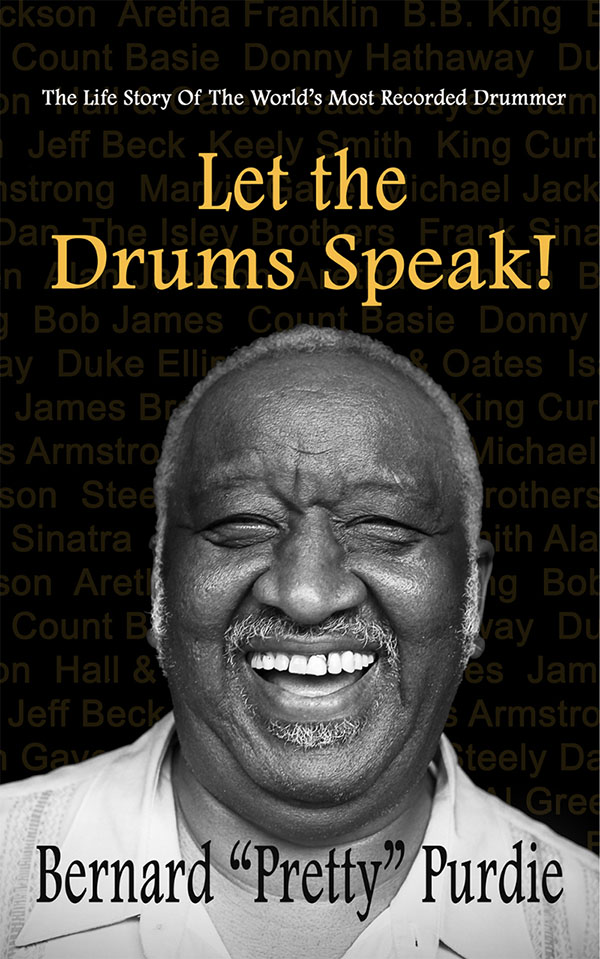
In January 2021 Purdie finally published the book he'd been promising for decades: "Let The Drums Speak!: The Life Story Of The World's Most Recorded Drummer". Strangely, despite being credited as the author, throughout the book Purdie refers to himself in the third person. And yes, there's a chapter titled, "The Ringo Starr Controversy" (which might more aptly have been titled "The Bernard Purdie Controversy"). Rather than "come clean" and set the record straight after all these years, Purdie doubles-down and proceeds to dig himself a deeper hole. For example, when his music students at The New School praised Ringo Starr's drumming, Purdie "couldn't let such a statement go unchallenged". So he told his class it was him, not Ringo, who'd played on the early Beatle recordings ... although a few pages later he admits it's "open to question" whether the drummer he overdubbed was Pete Best or Ringo Starr! What's "open to question" is Bernard Purdie's precarious relationship with the truth! |
|||||||
|
||||||||
Conclusion: I believe the only claim Bernard Purdie can make is this: He added some minor overdubs to some relatively insignificant tracks recorded in Germany fourteen months before Ringo even joined the band! To claim that he "fixed" or "replaced" Ringo's drums on twenty-one Beatle recordings -- or that "Ringo played on nothing" -- is a blatant fabrication. Fiction. A lie. |
||||||||
|
||||||||